


The Quick Read
- Each year, approximately 14,000 people are diagnosed with cervical cancer;
- Because cervical cancer is often asymptomatic, many patients are diagnosed at a late stage of the process when treatment may be less likely to be effective;
- More than 90 percent of cervical cancer cases could be prevented with screening and HPV vaccination;
- Unfortunately, many people are behind on their cervical cancer screening (nearly 1 in 4 in the US).
The Impact of Cancer and the Key Role of Prevention
Did you know that one of the top public health issues in the United States is cancer? In 2025, the American Cancer Society estimated that there would be almost 2 million new cancer cases in America alone. Of that 2 million, approximately 14,000 cases are estimated to include cervical cancer specifically.
Research has also shown that most cervical cancer cases affect women between the ages of 35 and 44. For women who do not participate in routine screening, early diagnosis can often be delayed because some women may not have any signs or symptoms in the early stages.
However, with advances in public health and medical technology, more than 90% of cervical cancer cases can be prevented with regular screening and timely HPV vaccinations. Despite this, cervical cancer screening dropped by 94% in 2020 and has remained 35% below pre-pandemic levels even after stay-at-home restrictions have been lifted. As a result, late-stage cervical cancers are on the rise.
February is National Cancer Prevention Month – let’s get back on track with cervical cancer screening.
What Is Cervical Cancer?
Before we can effectively prevent, diagnose, and treat cervical cancer, it’s critical for people to understand what cervical cancer is.
Cervical cancer is a cancer that affects the cells of the cervix. The cervix is the lower part of the uterus that connects the uterus to the vagina.
Cervical cancer was once one of the most common causes of cancer death in women. Fortunately, cervical cancer screening has played a significant role in improving health outcomes. Because prevention is so vital, here are a few tips you can follow to reduce your risk of developing cervical cancer
Prevention Tip #1: Get the HPV Vaccine
The vast majority of cervical cancer cases can be traced back to the human papillomavirus, typically referred to as HPV. This virus is sexually transmitted. Because it’s largely asymptomatic, it’s easy for one partner to spread it to another unknowingly.
The good news is that there is a highly effective vaccine that can help to protect against HPV. Most primary care providers recommend that both males and females get vaccinated at 11-12 years old as part of their routine vaccination schedule. You can still get vaccinated up to the age of 26 as part of routine vaccination. In some circumstances, you may be eligible for the vaccine up to age 45; this requires shared decision-making between you and your provider.
Prevention Tip #2: Practice Safe Sex
According to the CDC, approximately 9 out of 10 cases of cervical cancer can be linked to one or more strains of HPV. Since HPV is a sexually transmitted virus, there are several steps, in addition to vaccination, that you can take to reduce your risk of getting it. These include:
- Using latex condoms when having sexual intercourse with your partner.
- If you’re sexually active, get routinely screened for sexually transmitted diseases. It’s also important to have this discussion and share this information with your partners.
Prevention Tip #3: Get Screened for Cervical Cancer and HPV
One of the most important proactive steps that you can take to keep yourself safe and healthy is to get screened for cervical cancer and HPV regularly. Importantly, you need to get screened routinely even if you have been vaccinated for HPV.
Screening for cervical cancer can be done by a primary HPV test (the recommended screening test), or a co-test which pairs an HPV test with a Pap smear (based on your age and current guidelines).
A Primary HPV test can be conducted in clinic or self-collected at home using an FDA-authorized option like the Teal Wand. A co-test, however, can only be conducted by your provider, who uses a speculum and collects a small number of cells from your cervix, which is then sent to a lab for analysis.
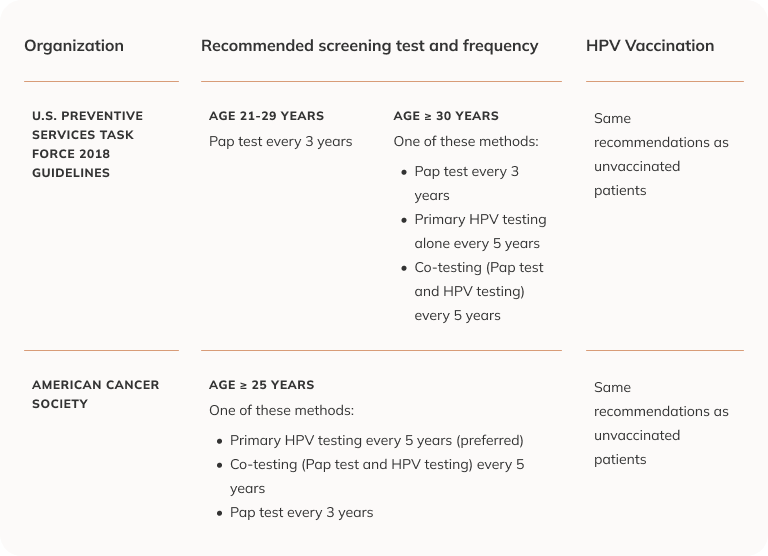
See below for current screening guidelines in the US:
Take Action Today
National Cancer Prevention Month is a reminder to make sure your cervical cancer screening is up to date and if eligible, receive the HPV vaccination.
Don’t wait to get screened. More comfortable screening options are now here. The Teal WandTM enables people to collect their own sample from home and mail it to the lab for primary HPV testing —no more uncomfortable speculum and stirrups at your doctor’s office. Check medical eligibility to get started and see if Teal is right for you.

.png)
