


The Quick Read
- Cervical cancer is often asymptomatic in the early stages, so having the ability to screen and detect the disease early can save lives.
- Detecting high-risk HPV is critical because it is the single most important risk factor in developing cervical cancer.
- Cervical cancer screening can be a three step process: collecting and mailing your sample, speaking with a provider, and if necessary, attending follow-up in person care.
Cervical cancer screening is recommended to start at a younger age than any other cancer screening, and spans forty years of a woman’s life (ages 25-65, as recommended by the American Cancer Society). It is an integral part of preventive care for women and critical for detecting disease early. Cervical cancer is often asymptomatic in the early stages, so having the ability to screen and detect the disease early can save lives.
Let’s break down the 3 critical steps of screening to prevent cervical cancer, with support from the Teal Health team.
But First, the Cervix
Cervical cancer is a type of cancer that starts in the cervix.
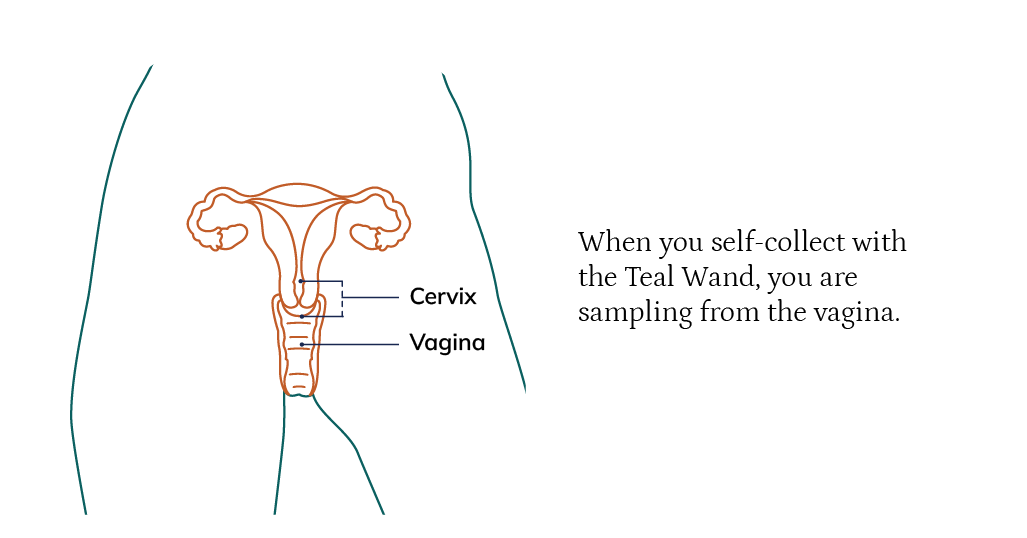
The cervix is the lowest portion of the uterus which connects the uterus to the vagina. When using the Teal Wand, cells are collected from the vagina, up near the cervix and tested for high-risk HPV (human papillomavirus).
Step 1: Collect and Mail a Sample
According to the American Cancer Society, cervical cancer rarely occurs in people who have been screening routinely for cervical cancer.
Screening has historically taken place in-person at your annual exam with your primary care provider or at your well-woman appointment with your OBGYN. And now, for the first time in the U.S., you can screen yourself at home, privately, using the Teal Wand. You will self-collect a sample and mail it to the lab to be tested on an FDA-approved primary HPV (human papillomavirus) test.
The Teal Wand is FDA-authorized, and samples detect precancer 96% of the time, the same as samples from the clinician using a speculum. It is easy and comfortable, with over 98% of users collecting an adequate sample.
Cervical cancer screening using an HPV test means collecting cell samples and testing them for the presence of high-risk HPV. Detecting high-risk HPV is critical because it is the single most important risk factor in developing cervical cancer.
How often should you screen?
According to the self-collection guidelines from the American Cancer Society:
- If you have a history of normal results, it is recommended that you screen yourself (self-collect) with a primary HPV test every 3 years.
- If you have a history of abnormal results in the past 5 years, in most cases, you will be recommended to screen again in 1 year to keep an eye on the infection (which can be dormant). If you’d like, you can also connect with a Teal provider to discuss further.
- If your results are abnormal, you should connect with a Teal medical provider to discuss whether additional tests or procedures are needed. Follow-up care is critical to ensuring HPV infections do not progress.
Once you have collected your sample, you will need to mail it to the lab, and within a week or so, you will be notified that your results are available to view in your Teal portal. All results are also reviewed by a Teal medical provider.
Step 2: Talk with a Teal Provider
If you received ‘abnormal’ results (HPV was detected in your sample), you need to schedule a virtual appointment with a Teal medical provider.
During the appointment, you and the provider will discuss your results in the context of your medical history and whether additional tests or treatments are recommended. Your Teal provider will give you a referral to a local provider for any recommended next steps. Please schedule this follow-up appointment with the Teal provider as soon as possible, as it is critical to take care of high-risk HPV infections before they cause cervical changes.
If you received normal results (no HPV detected), your provider will indicate in the note accompanying your results when you should screen next. However, if you still have questions or want to discuss further for any reason, you can message your Teal provider via the portal or book a visit.
Even if your results were normal, please let your Teal provider know right away if you learn anything new about your screening history, as you may need to be screened sooner.
Step 3: Follow-up Tests
When talking with a Teal medical provider, they may recommend further testing, such as an in-clinic Pap smear or a colposcopy. If so, the Teal medical provider will refer you to a local provider. This is a very important step in the screening process, and we recommend you schedule and complete the in-clinic follow-up visit using your referral as soon as you can. We will check in to remind you to do this.
Colposcopy
A colposcopy is an in-office procedure that usually takes about 15-20 minutes. It’s sort of like having a longer pap smear - after placing a speculum, your provider will apply a dilute vinegar solution to the area of concern, which turns any abnormal areas more white. Then, a magnifying device (a colposcope) is used to look for abnormal changes on your cervix. If abnormal areas are seen, your provider may take a small amount of tissue (a biopsy) for testing. This will then be sent to the lab for evaluation by a pathologist. Biopsy results are usually back within 1-2 weeks.
Precancer Treatment
Most of the time, if they are routinely screening, people have early precancerous changes, which can range from mild to severe. Depending on your age, the severity, and how much of your cervix shows these changes, you and your doctor can decide to wait to see if the changes clear on their own, or whether it is beter to undergo a treatment to remove the abnormal cells (e.g., ‘LEEP,’ Loop Electrosurgical Excision Procedure) to help prevent progression to cancer.
Cervical Cancer Treatment
In the unlikely event that your biopsy results show cancer, the provider who performed the procedure will advise you on what steps to take in order to treat your cervical cancer. Cervical cancer is treated in a way typical of most cancers, with surgery to remove the cancer, medicine to treat the cancer cells (chemotherapy), and/or radiation therapy.
Fortunately, cervical cancer is very treatable when caught early. You may be surprised to learn you have cancer because you may not be experiencing any symptoms. This is common when cervical cancer is detected early. More advanced cervical cancer can present with symptoms, such as abnormal bleeding or discharge after having sex, between periods, or after menopause.
Screening is the MOST important thing you can do to ensure you stay healthy.
If you need guidance or have questions at any point during your screening or follow-up care, please send us a message or make an appointment with a Teal provider. We are here to support you.

.png)
