


The Quick Read
- Your body naturally progresses towards perimenopause and menopause with age, however, it can also be prompted earlier if you undergo a procedure to remove your ovaries.
- Perimenopause occurs when the ovaries start producing less consistent estrogen, causing hormonal fluctuations and menopause is defined as twelve consecutive months without bleeding (without a suppressive hormone).
- Hormonal replacement therapy (HRT) is usually a combination of estrogen plus a progestin. There are various combinations of pills, patches, vaginal rings, sprays, and gels to consider.
- Replacing estrogen will typically provide relief of symptoms, but if you have a uterus you also need a progestin to keep the uterine lining thin and prevent uterine cancer.
- When estrogen is not recommended, there are a few non-hormonal treatments that work by reducing hot flashes and night sweats to improve your quality of life.
“I don’t feel like myself.”
“I can’t get a good night's rest.”
“Everything feels dry.”
“I can’t remember things like I used to.”
“I am eating and exercising the same and I still keep gaining weight.”
“I am hotter than Hades!”
“ I am much too young to be feeling this old.”
Does any of this sound familiar? These are examples of symptoms from real patients experiencing changes due to perimenopause and menopause. Your body naturally progresses towards perimenopause and menopause with age, however, it can also be prompted earlier if you undergo a procedure to remove your ovaries, such as an oophorectomy or a radical hysterectomy.
Below, we’ve shared our responses to the top questions regarding menopause symptoms and your treatment options.
How do I know when I am in perimenopause or menopause?
Perimenopause occurs when the ovaries start producing less consistent estrogen, causing hormonal fluctuations. Perimenopause can last months to years, typically beginning in your mid 40s, but can start earlier or later. Average onset is about 45 years old, and the average duration is 7-9 years. This hormonal “roller coaster” can cause women to experience major physical and even emotional changes, however the first indicator of perimenopause is often changes in your menstrual cycle. You may start to have either heavier or lighter flows, more or less time between cycles, or start skipping cycles altogether. We know this sounds broad, but you know your cycle best and if you start to experience changes, it is a pretty good indication that your transition to menopause has started.
Menopause is defined as twelve consecutive months without bleeding (without a suppressive hormone). The median age of menopause in the U.S. is 51 years old. Lower estrogen levels of menopause trigger a variety of symptoms and changes to women’s bodies. Although these are generally less dramatic than perimenopausal symptoms, they remain important considerations in women’s long term health.
______________________________________________________________________________
Do I need hormone tests to know if I am in perimenopause or menopause?
Perimenopause can be erratic, with hormone levels going up and down. Because of this, hormone testing is not done routinely to predict perimenopause. Additionally, every woman's baseline looks different and hormone levels don’t necessarily correlate to what symptoms each woman may experience. For example, two women with similar estrogen levels may experience very different amounts and severity of hot flashes.
Instead, you can work with your provider to rule out any other causes related to the symptoms you are experiencing. For example, some women who have new onset joint pain, may get an evaluation for rheumatologic diseases before assuming it's just perimenopause. There are additional labs that can be run to rule out other medical conditions, such as thyroid disorders or anemia, as some of the symptoms can overlap.
______________________________________________________________________________
What are the symptoms of low estrogen?
Symptoms can overlap from perimenopause and menopause, and what each woman experiences can vary widely. Some of the most common symptoms include:
- Vasomotor symptoms (hot flashes & night sweats): are the most common symptoms. Estrogen affects the temperature regulation center of the brain, with lower estrogen hot flashes and night sweats can be triggered.
- Mood changes (anxiety, irritability): estrogen affects the levels of serotonin and norepinephrine levels which regulate mood.
- Brain Fog: less studied but widely reported, brain fog can occur during perimenopause and menopause. Fortunately, it does seem to be a temporary condition.
- Sleep issues: frequent wakings from vasomotor symptoms and/or stress can all lead to poor sleep.
- Joint pains: estrogen reduces inflammation and helps cartilage turnover, so the lower estrogen levels can cause women to experience increased pain in joints such as hips, shoulders, and knees.
- Vaginal irritation, pain, & dryness: because estrogen makes the cells of the vaginal walls to become thicker, more elastic, and lubricated, many women experience vaginal dryness with less estrogen.
- Urinary symptoms: less estrogen leads to thinner cells of the vulva and urinary tract tube, causing pain, urgency, and increased risk for urinary tract infections.
- Hair issues: lower estrogen can lead to drier hair, hair loss, and even excess facial hair.
- Weight loss challenges: changes in weight distribution (more to the abdomen) and metabolism is triggered by lower estrogen levels.
______________________________________________________________________________
What are my hormone replacement treatment (HRT) options?
Hormonal replacement therapy (HRT) is usually a combination of estrogen plus a progestin.
There are various combinations of pills, patches, vaginal rings, sprays, and gels to consider. Which form of HRT you use will depend on the dosing you need, preferred route, and sometimes your drug plan coverage.
Replacing estrogen will typically provide relief of symptoms, but if you have a uterus you also need a progestin to keep the uterine lining thin and prevent uterine cancer.
During perimenopause, symptoms are often managed with birth control pills, the vaginal ring, or a combination of a progesterone IUD with an estrogen patch. These will override the menstrual cycle, provide birth control, and keep hormone levels consistent, thus reducing symptoms.
During menopause, we try to use the lowest effective dose of estrogen that relieves symptoms. Also, using a transdermal (patch, gel, spray) form of estrogen is preferred to oral estrogen to reduce the risk for blood clots. Oral estrogen gets processed through the liver, triggering the release of clotting factors. Taking estrogen transdermally reduces this mechanism. The progesterone is most often taken as a nightly pill, but the progesterone IUD is also an option.
______________________________________________________________________________
What are bioidentical hormones?
Bioidentical means the same chemical compound that our bodies make.
Estradiol (E2) is a bioidentical form of estrogen because it is produced by the ovaries, is the most potent form of estrogen, and the main source in our reproductive years. Most prescription estrogen products (including patches, tablets, sprays, creams, and gels) are made from estradiol (E2) so are bioidentical.
Micronized progesterone (prometrium) is bioidentical progesterone in pill form.
Compounded HRT (made in a specialty pharmacy) is often marketed as “bioidentical” but is not regulated by the FDA nor recommended by the American College of Obstetricians and Gynecologists because these products are not required to go through studies for safety or effectiveness and can have less consistent ingredients.
______________________________________________________________________________
What are my options if I am unable to take estrogen?
For example those with a history of blood clots, an estrogen sensitive cancer (ie. breast cancer), or heart disease should not take estrogen as the risks are felt to outweigh potential benefits.
Here are a few non-hormonal treatments that work by reducing hot flashes and night sweats to improve your quality of life.
Non-hormonal prescriptions
- Neurokinin B inhibitor (Veozah): a new class of drug, FDA approved in 2023, to reduce hot flashes and night sweats by regulating the brain’s temperature center.
- Antidepressants (e.g., Paxil): has potential to also help with mood changes.
- Seizure medication (Neurontin): helpful for night sweats and insomnia as it causes drowsiness.
- Oxybutynin (Ditropan): also treats overactive bladder. Possible adverse events include dry mouth and urinary difficulties.
Hypnosis therapy and Cognitive Behavioral Therapy (CBT)
Can improve vasomotor symptoms, reducing hot flashes and night sweats. Involves working with a therapist to identify and change negative thoughts and behavior. This process can take weeks to months to see full results.
Weight loss
Has been shown to lower the rates of vasomotor symptoms, more so for those in perimenopause than in menopause.
Exercise routines
Not proven to provide relief of vasomotor symptoms but good for many other reasons, including stress reduction, reducing brain fog, and weight maintenance.
Should include HIIT (high intensity interval training), strength training, and intentional recovery (hydrate, incorporate rest days during the week, and fuel your body after workouts with protein to help increase muscle and muscle recovery). These will all help to reduce insulin resistance, improve bone density, and maintain muscle.
Meditation, tai chi, yoga
Not proven to provide relief of vasomotor symptoms, but recommended for stress and brain fog reduction, better balance, and flexibility.
Soy, black cohosh, evening primrose oil, maca
None are FDA regulated and may not be studied rigorously for relief of menopausal symptoms. Not proven to provide relief of vasomotor symptoms.
Check with a provider first to be sure they are safe with your medical history and other prescriptions. Follow recommended dosage by provider. More may not be better!
______________________________________________________________________________
What can I do for vaginal dryness?
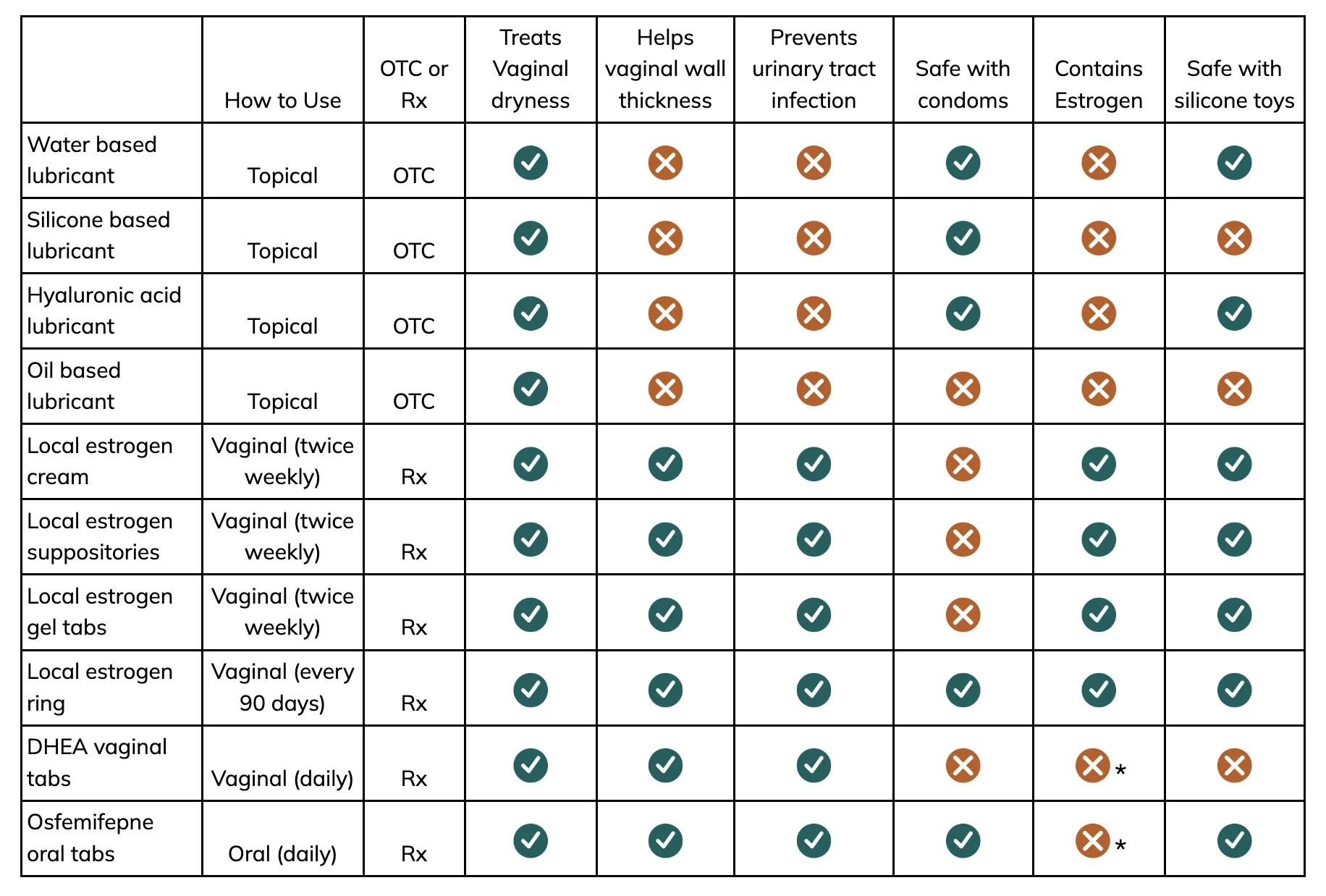
See more information. * DHEA and Osfemifepne both promote local vaginal estrogen
Lubricants
Increase vaginal hydration, reducing dryness and discomfort.
- Water based: KY, Astroglide (dries quickly so less ideal in menopause)
- Silicone based: Pjur, AstroglideX, Replens, Uberlube
- Hyaluronic acid based: Revaree, Good Clean Love
- Oil based: coconut oil, olive oil, petroleum jelly (do not use with condoms!)
Estrogen
Applied locally helps to hydrate the cells lining the vagina and urinary tract. This improves discomfort and lowers the risk of urinary tract infections. It does not raise blood levels of estrogen, so no progesterone is needed with this treatment.
- Creams: Estrace (estradiol) and Premarin (conjugated equine estrogens) used twice weekly
- Gel inserts: Imvexxy (estradiol) used twice weekly
- Tablet suppositories: Vagifem, Yuvafem (estradiol) used twice weekly
- Ring: Estring (estradiol) each vaginal ring lasts 90 days
DHEA/prasterone
Intrarosa: nightly vaginal insert that supports the local vaginal tissue. DHEA is changed into estrogen and androgens in vaginal tissue.
Ospemifene
Osphena: a daily non-hormonal oral pill that promotes estrogen selectively in the vaginal tissues. Good for those who don’t want to use local vaginal products and/ or for those who prefer to avoid estrogen.