
The Quick Read
- The Pap smear, introduced in 1941 and named after its inventor, George Papanicolaou, represents the first effort to detect early cancer.
- The Pap smear screening experience, using the speculum and brush, hasn't evolved in 80+ years and the “modern” speculum is 150+ years old.
- The 1980s brought on the discovery that human papillomavirus (HPV) causes more than 90 percent of cervical cancers. This evidence led to the introduction of the HPV vaccine and the Primary HPV test for screening.
- Some countries, including Australia, have already adopted a national self-collect screening option and now they are on their way to eliminate cervical cancer in the next 10-15 years!
- In 2025, self-collection in the US became a reality with the Teal Wand's FDA authorization, and is now recognized as an accurate screening method by ACS, HRSA, USPSTF, and ACOG.
*May 2025 Update: The Teal Wand self-collection device for at-home cervical cancer screening is FDA-authorized. Check medical eligibility to get started and see if Teal is right for you.
At Teal Health, we’re constantly thinking about the future of healthcare. Today, women can screen for cervical cancer from the comfort of their own homes using the FDA-authorized Teal Wand at-home self-collection device. We're working to overcome the many barriers that prevent people from getting screened for this highly preventable disease.
A future that takes women’s health — and women’s pain — and we're proud to be part of it. It’s been a long time coming. In honor of Cervical Cancer Awareness Month, let’s take a look back through the history of cervical cancer screenings to better understand where we started, and where we’re going.
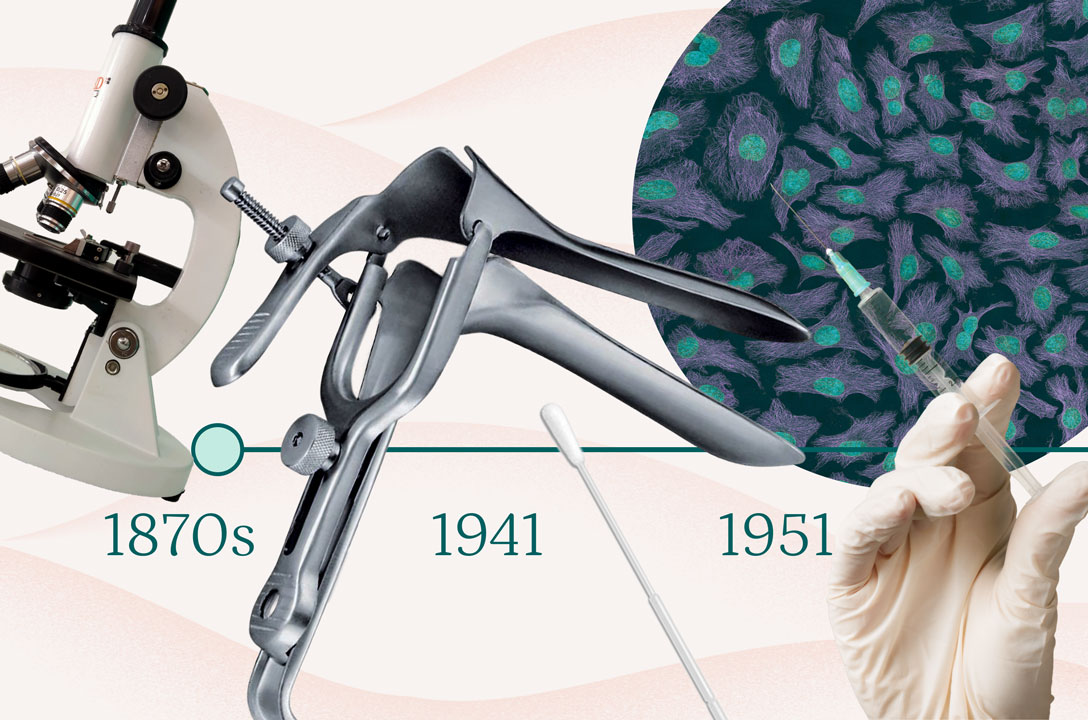
1870-1951: The speculum, Pap smear, and HeLa cells
While a mechanism resembling the modern speculum dates back to at least the Roman Empire, its invention is credited to James Marion Sims, the very controversial “father of gynecology,” in the 1870s. Sims tested the speculum (which is used for dilation and examination of the vagina) on enslaved Black women, often without anesthesia.
The legacy of using Black women’s bodies without consent to achieve gynecological progress unfortunately does not end with Sims. Before Henrietta Lacks, a Black woman, died from aggressive cervical cancer in 1951, clinicians extracted a slice of her cervical tissue without her consent. These cells reproduced themselves countless times and the “immortal” HeLa cells have contributed to countless medical breakthroughs over the decades and are said to have saved more than 10 million lives.
Ten years before Henrietta Lacks died, the Papanicolaou (Pap) smear was introduced in 1941. The test was named after its inventor, George Papanicolaou. The Pap smear represents the first effort to detect early cancer. Prior to its invention, cervical cancer was the leading cause of cancer-related death among women in the US.
1980-2006: HPV and cervical cancer
The 1980s brought on the discovery that human papillomavirus (HPV) causes more than 90 percent of cervical cancers. This evidence led to the introduction of the HPV vaccine in 2006 for children and teens (and was later expanded to include young adults). According to the CDC, HPV vaccines are close to 100 percent effective for the prevention of persistent HPV infection.
In the 1990s, because of increased screening, the incidence of cervical cancer mortality declined by more than 70 percent from the 1950s.
2014-2020: Recommendations change for exams
Up until 2014, Pap smears were the only test for cervical cancer. That year, the FDA approved the first test using HPV as the primary screen for cervical cancer. The HPV test is still performed with a speculum, but the collected sample is tested differently. The HPV test, which is a more sensitive screen for cervical cancer than the Pap smear, looks for the presence of the virus as opposed to abnormal cells. In 2020, the American Cancer Society endorsed the primary HPV test as the preferred screening test for cervical cancer.
Also in 2014, the American College of Physicians argued that pelvic exams are not necessary for non-pregnant women who are not experiencing any problems. In 2018, the American College of Obstetricians and Gynecologists (ACOG) published similar recommendations.
On November 17, 2020, the World Health Organization (WHO), along with all 194 members, announced a global strategy to accelerate the elimination of cervical cancer as a public health problem. Australia has vowed to become the first country in the world to do so, by 2035. Canada and England have pledged to do the same by 2040.
2021-Present Day: Initiatives to end cancer and self-collect for Australians
Over half of the cervical cancer cases in the US are among women who have never been screened or are infrequently screened. As a result, in 2021, the National Cancer Institute launched its cervical cancer "Last Mile Initiative.” This initiative is to accelerate the approval of self-sampling for HPV testing. This will provide an alternative screening approach for people who do not or cannot access a clinic‐based, speculum exam for cervical cancer screening.
In February 2022, the Biden-Harris administration reignited the Moonshot to End Cancer initiative and set a goal of reducing the cancer death rate by at least 50 percent over the next 25 years. The initiative includes a specific call to action to help ensure equitable access to screening and prevention through at-home, self-collect methods.
In July 2022, self-collect for cervical cancer screening became available to all Australians. While self-collect was first introduced in the country in 2017, it was restricted to under-screened individuals. By introducing self-collect, Australia has seen the screening rates for cervical cancer rise and death rates drop. Australia aims to eradicate cervical cancer by 2035 (!!).
2024-2025: Self-collect becomes a reality in the US with the Teal Wand
It's been more than 80 years since the inception of the Pap smear, and since then, the speculum was the only tool used to collect a sample to screen for cervical cancer, in a clinic. A change was long overdue. In May 2024, the FDA approved the first in-clinic self-collection methods for cervical cancer screening, and Teal Health received FDA Breakthrough Device Designation for the Teal Wand. By May 2025, the Teal’s Wand became the first FDA-authorized at-home self-collection device for cervical cancer screening in the US.
2025-2026: Self-collect becomes the recommended standard
Once at-home self-collection was available, the major screening guideline bodies began recognizing it as an accurate option. In December 2025, the American Cancer Society updated its cervical cancer screening guidelines to include self-collected primary HPV testing. In January 2026, HRSA followed suit, and ASCCP updated its guidance to include the Teal Wand specifically. In April 2026, ACOG aligned its guidelines to recommend primary HPV testing and self-collection as well. As of today, self-collected primary HPV testing is recognized as an accurate cervical cancer screening method by ACS, HRSA, and ACOG — with USPSTF's draft update also including it.
More than 80 years later, women finally have another option. It's now a screening method recognized by the country's leading medical organizations. This is simply the next chapter.
Check medical eligibility to get started and see if Teal is right for you.

.png)
